Sometimes the reason an outfit doesn’t look quite right has nothing to do with the top, shoes, jacket or accessories.
It may be the jeans.
And here’s what makes denim tricky: a pair of jeans can technically fit. They button. They’re comfortable. You like the wash. You may even love the style.
But small details in the fit, rise, leg shape, hem length and fabric can change the proportions of everything you wear with them.
A higher rise changes where your torso appears to end. A wider leg opening adds visual weight toward the bottom of the outfit. Extra fabric at the hem changes how the jeans interact with your shoes. Even the placement of the back pockets can change the lines you see from behind.
So rather than asking whether a particular jean style is “flattering,” I think there’s a much more useful question:
What are the jeans actually doing?
Once you learn how to answer that, it becomes much easier to understand why one pair works beautifully in your wardrobe while another pair never seems quite right.
Watch: The Jeans Mistakes That Throw Off Your Entire Outfit
1. Don’t Assume Jeans Fit Just Because They Button
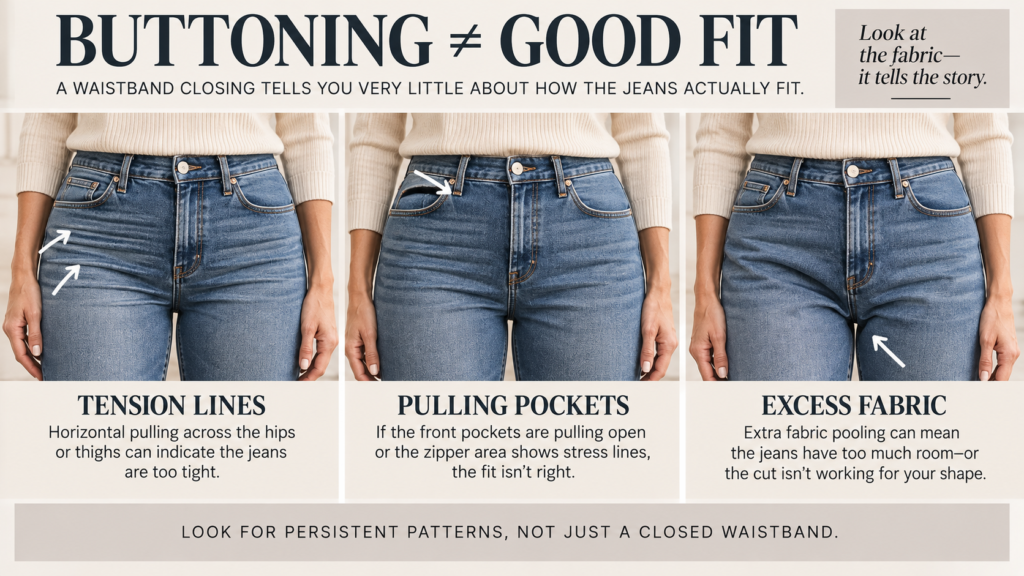
A waistband closing tells you surprisingly little about how the rest of the jeans fit.
Instead, start by looking at the fabric.
Strong horizontal pulling across the hips or upper thighs can indicate that the denim is under tension. Front pockets pulling open or pronounced stress lines around the zipper are other details worth noticing.
But the opposite can happen too.
Excess fabric pooling around the crotch or upper thigh may mean there’s more room than you need—or simply that the particular cut isn’t working with your proportions.
Of course, denim is supposed to crease. Jeans move with us, so the goal isn’t perfectly smooth fabric.
What you’re looking for are persistent tension or excess-fabric patterns that remain when you’re standing naturally.
2. Pay Attention to the Rise
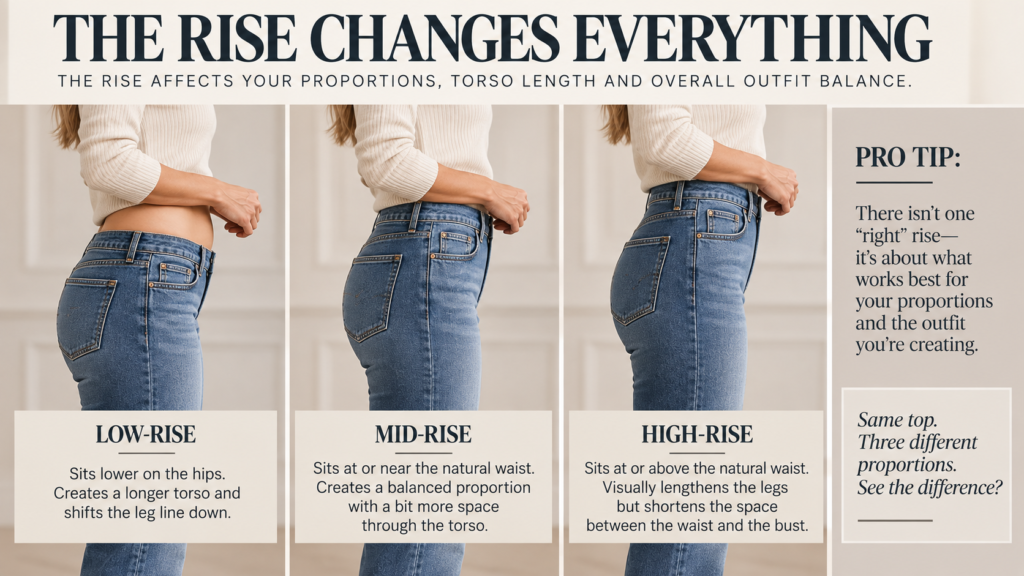
High-rise, mid-rise and lower-rise jeans do more than change where the waistband sits.
They change the proportions of the entire outfit.
A higher rise visually raises the point where your legs begin. That can create a long leg line, but it also reduces the amount of visible space between your waistband and upper body.
Add a tucked top and cropped jacket, and that middle section becomes even more compact.
A mid-rise creates more visible space through the torso, while a lower rise moves the dividing line farther down.
None of those options is universally better.
The mistake is choosing a rise entirely because it’s trending without considering what that waistband placement does to the rest of the outfit.
3. “Straight-Leg” Isn’t One Jean Shape
This is one of the reasons shopping for denim can be so frustrating.
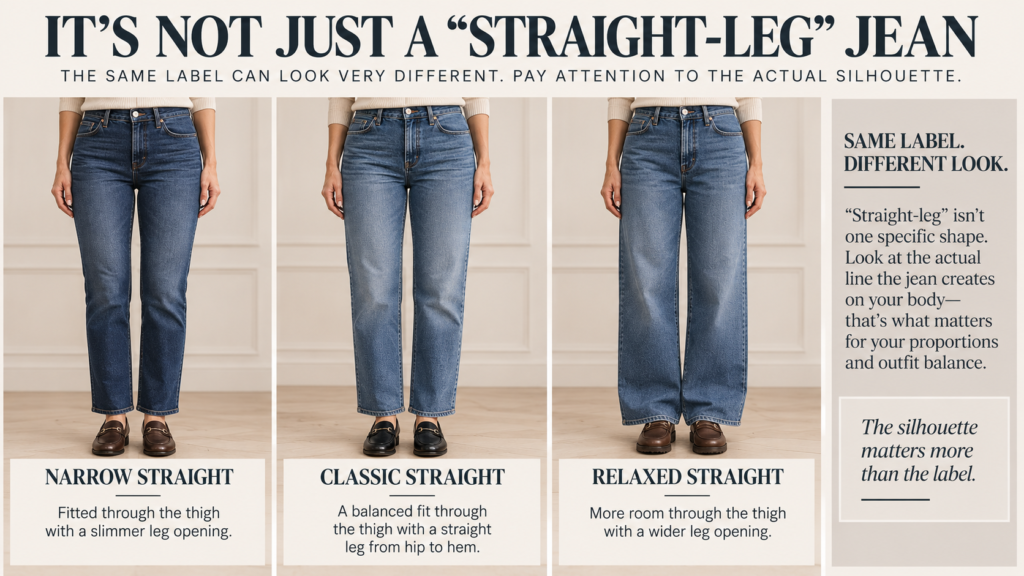
Two jeans can both be labeled straight-leg and look completely different.
One may fit relatively close through the thigh before continuing into a narrow opening.
Another may fall almost vertically from the hip.
And another may have enough room through the thigh and calf to look more relaxed.
Those differences change the amount of visual volume the denim brings to your outfit.
So instead of relying exclusively on the product description, look at the actual silhouette the jeans create on your body.
The silhouette matters more than the label.
4. Don’t Forget the Side View
Most of us evaluate jeans from the front.
Turn sideways before deciding how they fit.
The side view can reveal things you don’t immediately notice head-on.
Look at the waistband. Does it stay relatively close to the body, or is there a significant gap?
Look at the hip and upper thigh. Does the fabric fall naturally, or does it pull forward?
Then follow the leg toward the floor. Is the denim falling in the direction you expected, or is excess fabric pushing the silhouette outward?
This can be especially helpful when two pairs look nearly identical from the front.
Sometimes the side view immediately explains why one pair feels better than the other.
5. Back-Pocket Placement Changes What You See
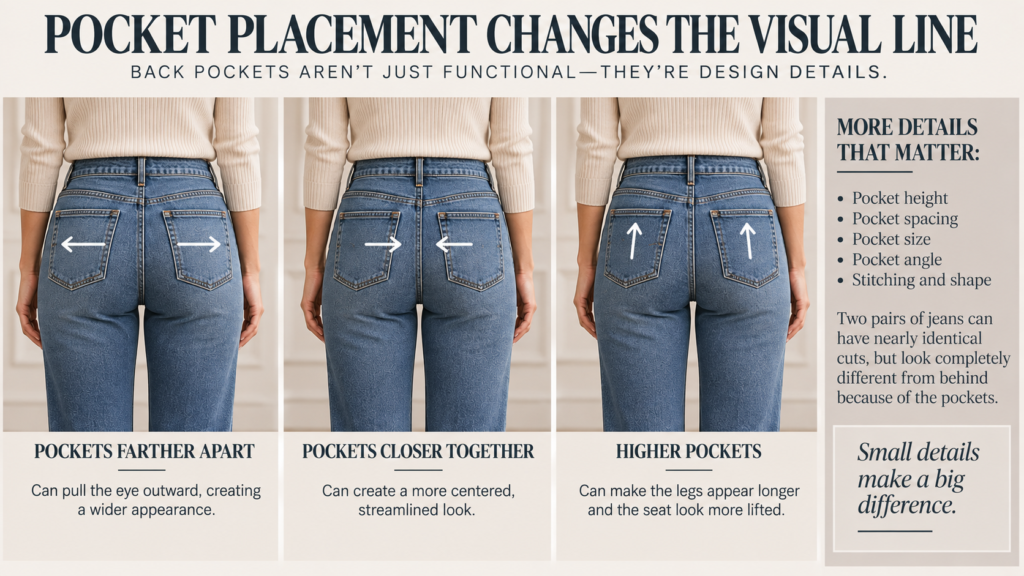
Back pockets aren’t merely functional.
They’re also design lines.
Pockets positioned farther apart pull the eye outward. Pockets positioned closer together concentrate the visual line toward the center.
Pocket height matters too, as does the angle of the pocket.
A slightly angled pocket creates a different directional line from a very square or horizontal pocket.
There isn’t one pocket configuration everyone needs to wear.
But if you’ve ever tried on two similar jeans and wondered why they look surprisingly different from behind, pocket placement may be one of the reasons.
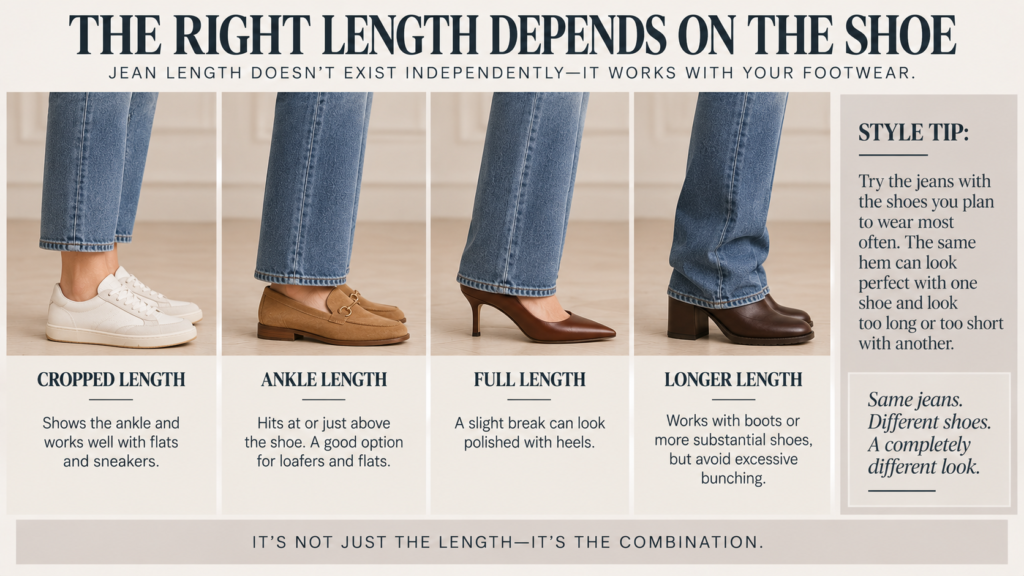
6. Jean Length Doesn’t Exist Independently of Your Shoes
This is one of the most useful denim lessons to remember:
The “right” jean length depends partly on the shoe you’re wearing.
A hem that works beautifully with a heel may collapse onto a flat.
An ankle-length jean that works with a ballet flat or loafer creates a very different relationship when you add an ankle boot.
And a full-length jean may fall beautifully over a streamlined shoe while bunching heavily over something more substantial.
So instead of asking:
“Are these jeans the right length?”
Try asking:
“Are these jeans the right length for the shoes I want to wear with them?”
That’s a much more useful question.
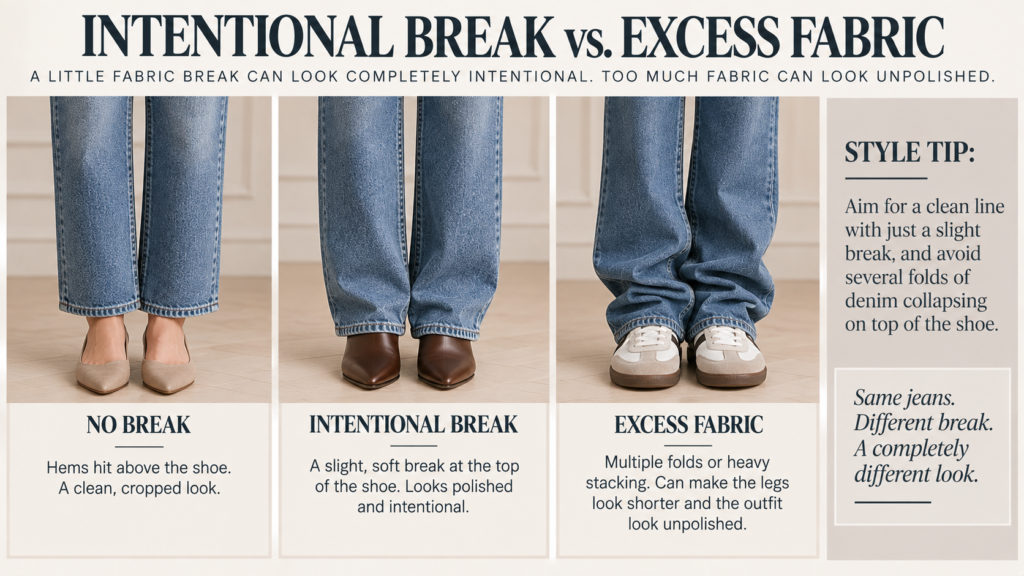
7. Intentional Fabric Break and Excess Fabric Aren’t the Same Thing
A small break where the denim meets the shoe can look completely intentional.
Several folds collapsing around the ankle create something very different.
Every additional fold introduces another horizontal line near the bottom of the outfit.
That can interrupt what would otherwise be a clean vertical line through a straight-leg jean.
If you notice a lot of bunching around your shoes, try comparing the same jeans with a slightly higher heel or a shorter inseam.
You may discover that the outfit suddenly looks cleaner without changing anything else.
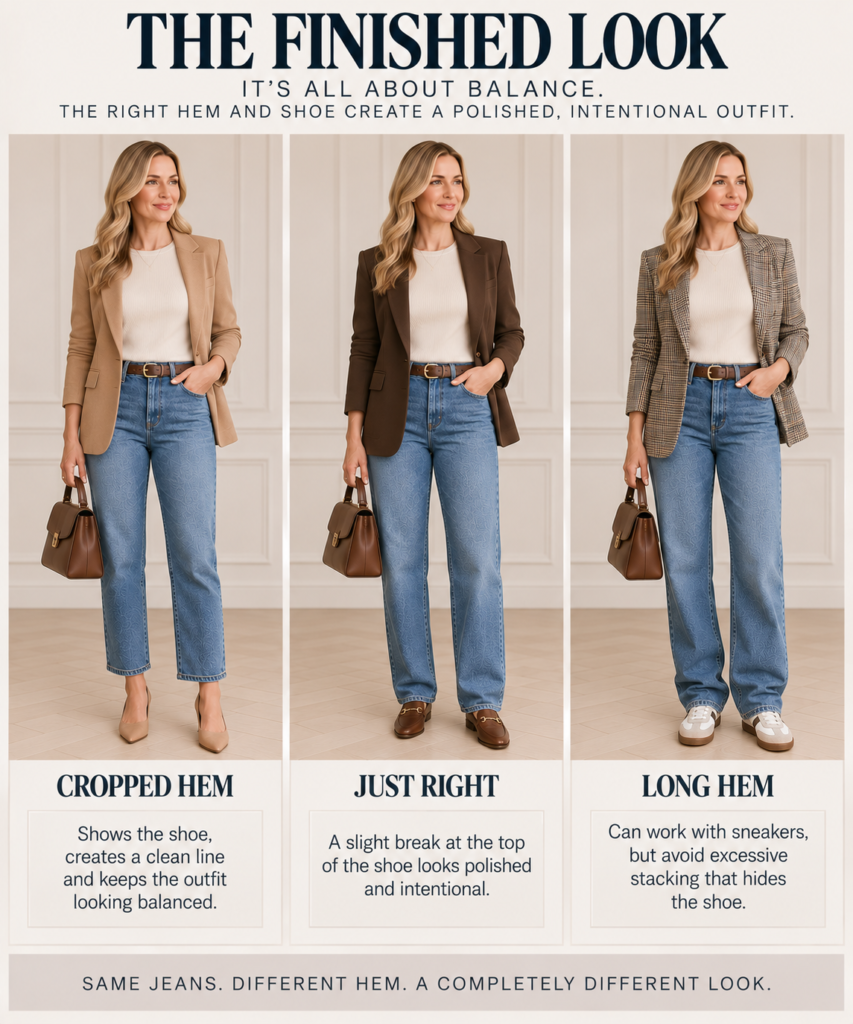
8. Sometimes the Jeans Aren’t Too Wide—the Outfit Needs Balance
A jean doesn’t have to technically be “wide-leg” to bring quite a bit of visual volume to an outfit.
A relaxed straight jean with a longer inseam, substantial denim and wider opening may carry considerably more visual weight than a slim straight jean.
Pair that with a tiny fitted top and very delicate shoe, and most of the outfit’s visual substance becomes concentrated below the waist.
That doesn’t necessarily mean the jeans are wrong.
Try repeating some of that visual weight elsewhere with a structured knit, blazer, jacket, handbag or slightly more substantial shoe.
Now you’re balancing the whole silhouette rather than trying to make the jeans smaller.
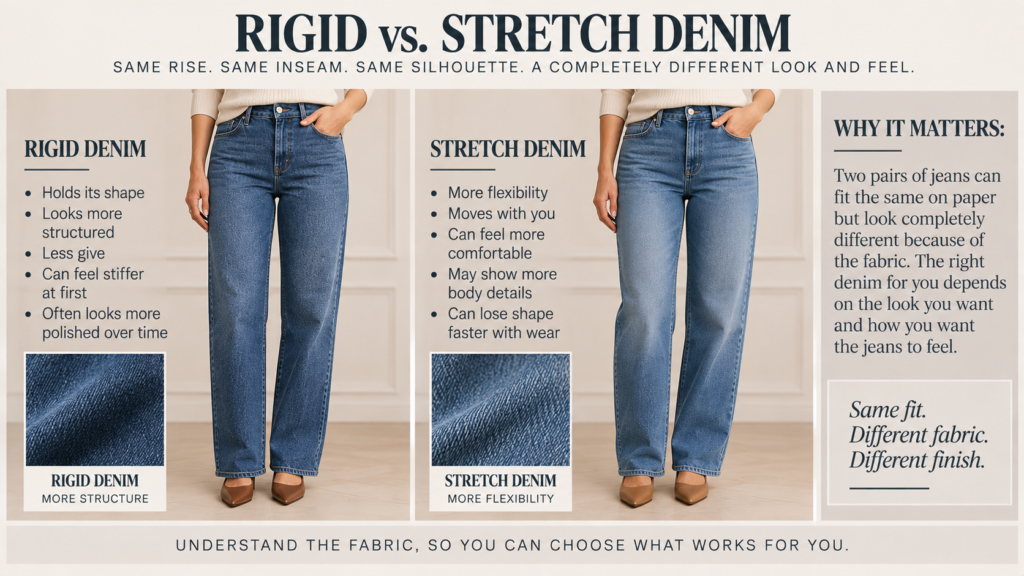
9. Fabric Composition Changes How Jeans Behave
Two jeans can have the same rise, inseam and basic silhouette and still look quite different.
Why?
The fabric.
Rigid denim generally holds its shape more firmly. That can create a structured, almost architectural straight-leg silhouette.
Denim containing more stretch tends to follow the body more closely and move more easily.
Neither is inherently better.
But if you’re expecting a jean to create a structured straight line and choose an extremely soft, stretchy denim, the finished silhouette may not behave like the product photograph you had in mind.
When you’re shopping, don’t only look at measurements.
Check the fabric composition, too.
You’re choosing both the shape of the jeans and how that shape will behave.
10. Stop Letting the Size Number Decide Whether Jeans Fit
The number printed inside your jeans is useful for finding a starting point.
That’s about it.
Sizing can vary between brands. It can vary between styles within the same brand. Different washes and fabric compositions can sometimes fit differently too.
If a pair of jeans creates the silhouette you want in a larger numerical size than you normally wear, that doesn’t make it the wrong size.
The better question is whether the jeans have enough room to create the shape they were designed to create without unnecessary pulling, collapsing or distortion.
Fit the body—not the number on the tag.
A Simple 3-Step Jean Fit Check
The next time you put together an outfit and something feels off, resist the urge to immediately start changing your top, shoes, belt and handbag.
Check the jeans first.
1. Look at the Waist-to-Hip Area
Are there persistent tension lines?
Are the pockets pulling?
Is there excessive fabric?
And where is the rise placing the visual division between your torso and legs?
2. Follow the Leg to the Floor
What silhouette are the jeans actually creating?
Slim straight?
Classic straight?
Relaxed straight?
Where does the hem end?
And what happens when that hem meets your shoe?
3. Turn Around
Look at the pocket height, spacing and angle.
Then look at how the denim falls from the hip.
Sometimes the detail explaining why one pair looks different from another isn’t visible from the front at all.
Shop the Denim Edit
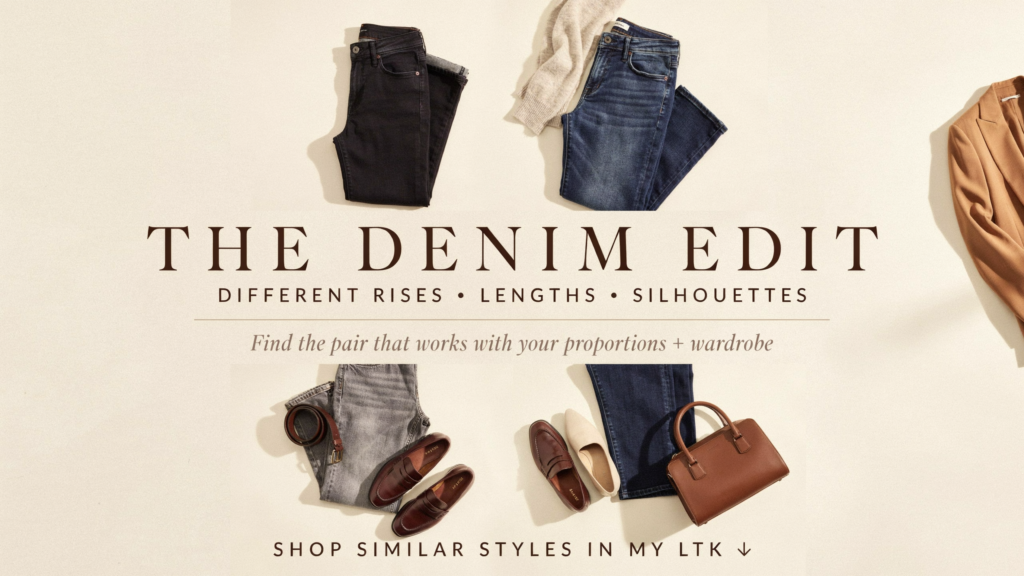
If you’re looking for jeans with some of the different fits and silhouettes discussed here, I’ve put together a denim edit in my LTK with examples of ankle-length, classic straight, relaxed straight and longer silhouettes.

The goal isn’t necessarily to buy a specific pair. Use the options to compare rises, inseams, fabric compositions and leg openings and determine which characteristics make the most sense for your wardrobe.
The Bigger Lesson: Learn to Read Your Clothes
The most useful shift I’ve made when thinking about clothing is moving away from the question:
“Is this flattering?”
and toward:
“What is this garment actually doing?”
Where is it creating a line?
Where is it adding volume?
Where is the fabric under tension?
Where does the garment end?
And how does all of that interact with everything around it?
Those questions are far more useful than memorizing another list of fashion rules because they allow you to evaluate your own clothing on your own body.
Jeans are a particularly good place to practice because they create such a large portion of the silhouette.
Once the jeans are working with the proportions of the outfit, everything you put around them becomes easier to style.
Watch the Full Jeans Fit Guide
Want to see these differences side by side?
Watch The Jeans Mistakes That Throw Off Your Entire Outfit on Get Trendy With Wendy.
And next, we’re moving to another wardrobe staple we frequently pair with denim:
Why Some Blazers Look Amazing With Jeans — And Others Don’t.